
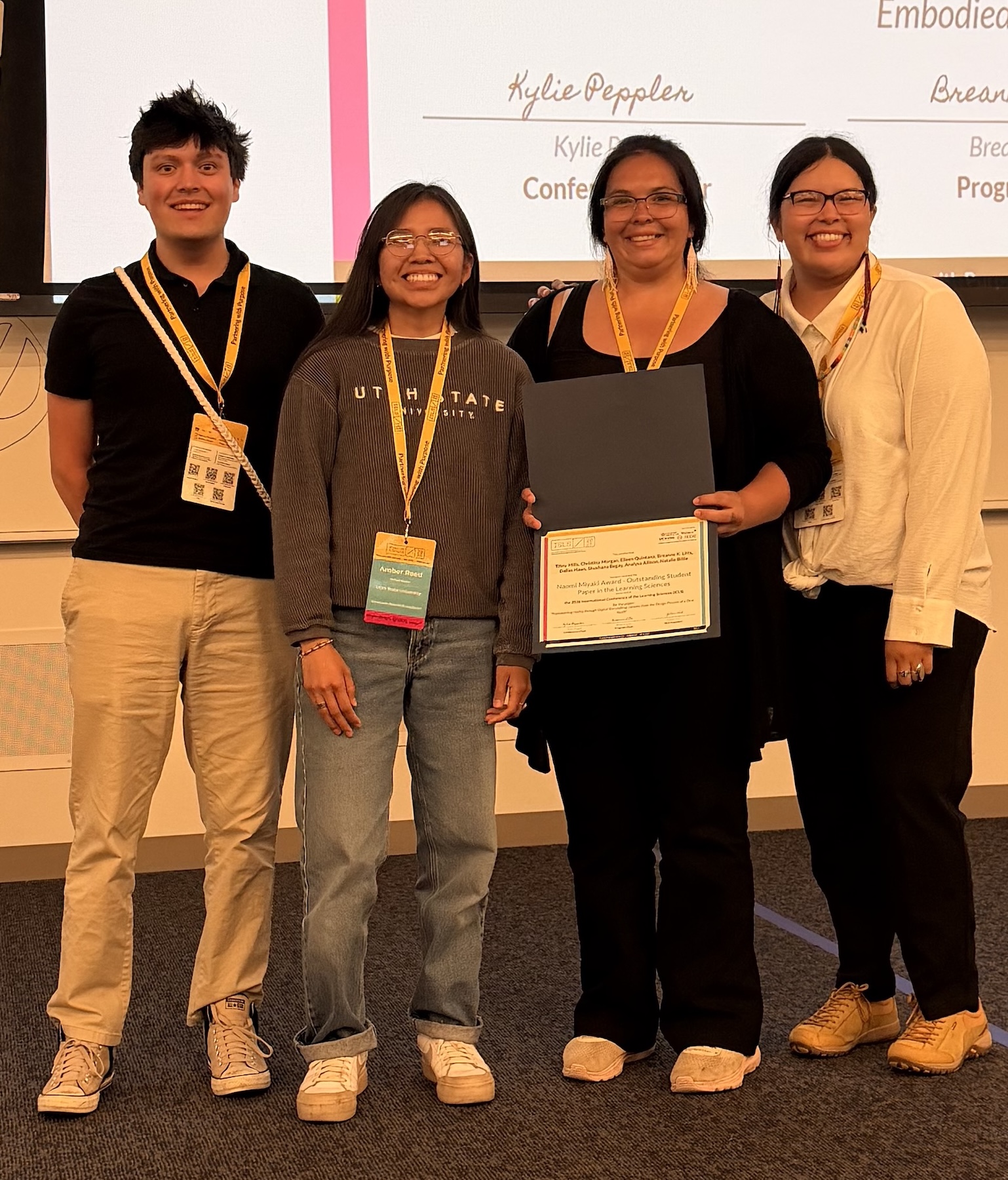
Left to right: Dallas Haws, Amber Reed, Tifiny Mills, and Christina Morgan.
ITLS had a meaningful presence at ISLS 2026, with 29 faculty members, postdoctoral researchers, and students contributing across sessions throughout the week. One of the key highlights of the conference was the recognition of Dr. David Feldon and co-authors Dr. Umar Shehzad (postdoctoral researcher) and Spenser Clark (doctoral student), whose work received the Best Long Paper Award. Their paper introduced a new approach to measurement that brings context into the center of quantitative research, addressing a long-standing challenge in the learning sciences. Another exciting moment for the ITLS community came as one of our collaborative research teams received an ISLS conference award for its work with Native educator community partners. Led by Tifiny Mills, an undergraduate researcher in ITLS, and Christina Morgan, an ITLS doctoral candidate, the project demonstrates how digital storytelling can empower Indigenous youth to preserve culture, share stories, and strengthen community through meaningful learning experiences. The celebration didn't stop there; another collaborative project, led by Dallas Haws (Program Coordinator for CLASP Collaborative) and Tribal partners, was recognized as a finalist for the Outstanding Poster Award.
Dr. Deborah Fields also contributed important work on equity, different ways of knowing, and humanizing computing in CS education. During the conference, she was elected as the new Finance Co-Officer of the ISLS society, continuing ITLS representation in leadership roles. Dr. Kristin Searle will continue serving as co-chair of the Finance Committee, further supporting the society’s governance and community work.
Additionally, ITLS faculty, postdocs, and students were active across many sessions throughout the conference, contributing research that reflected the breadth of work in learning sciences, design-based research, and technology-enhanced learning. These sessions created space for rich discussion and exchange across different strands of the program.
One of these contributions came from Dr. Ariel Han, who presented in the CSCL AI–Human Interaction session on co-designing AI-supported tools with Teachers of Students with Visual Impairments (TVIs) to support early mathematics learning for blind and low-vision students. Reflecting on the conference, Dr. Han shared that engaging with researchers, exploring interactive demonstrations, and visiting the arts exhibition were especially inspiring parts of the experience.
Dr. Lisa Lundgren also shared a strong set of contributions through three presentations spanning scientific literacy, identity, and informal learning environments: Designing Comic Cons for Scientific Literacy and Sustained Engagement by Dr. Eric Kirk, Dr. Lundgren and Gabriel-Philip Santos; Manga as Counterspaces for Queer Youth Identities by Dr. Lundgren, Dr. Khahn Q. Tran, Dr. Mario I. Suárez, and Colby Tofel-Grehl; and Bridging Theory and Practice: A Design-Based Research Approach to Strengthening Evaluation in Science Museums by Kari Ross Nelson and Dr. Lundgren. All were very well-received and held in great sessions with thoughtful presenters and chairs.
Beyond the research presentations, ISLS 2026 also celebrated creativity and community. Dr. Lisa Lundgren described the conference as an enlightening and invigorating experience, highlighting its emphasis on analog art, play, and hands-on learning alongside traditional research presentations. One particularly memorable moment shared by several participants was a symposium where attendees were invited to create artwork reflecting on their conference experiences. The process of making and later seeing the collective exhibition added a reflective and creative dimension to the conference that many found especially meaningful.
The conference concluded with a Juneteenth celebration that left a lasting impression. Reflecting on the event, Jared Arnell shared, "The Juneteenth celebration at the end of the conference was so beautiful! I'm so grateful to take part in such a diverse and loving community."
Overall, ISLS 2026 was an important moment for ITLS, bringing together recognition, active scholarship, and a strong sense of community across faculty, postdoctoral researchers, and students.

Dr. David Feldon's team received the Best Long Paper Award

Dr. Litts' research team received an ISLS conference award


Left to right: Anahita Ashineh, Asmaa Yazidi Alaoui, Jared Arnell.
