
NSF CAREER Grant Awarded to Assistant Professor to Investigate Elementary Student Interest, Confidence, and Achievement in Mathematics
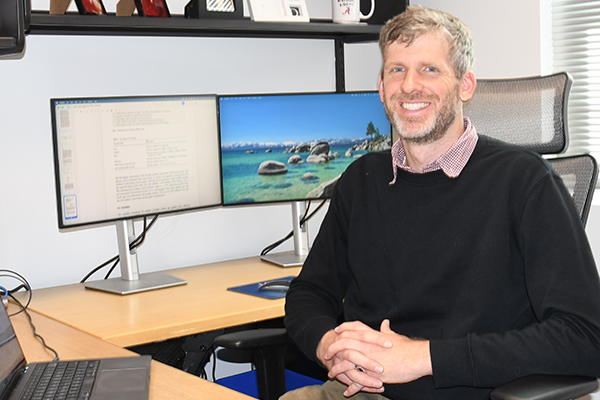
Tye Campbell, Ph.D., assistant professor in the School of Teacher Education and Leadership at USU.
Tye Campbell, Ph.D., assistant professor in the School of Teacher Education and Leadership within the Emma Eccles Jones College of Education, Health and Human Sciences, was recently awarded a CAREER grant from the National Science Foundation (NSF) to investigate how and why elementary students experience changes in mathematics-related affect—beliefs, attitudes, and emotions—and achievement as they progress through grades 2 to 5. The five-year NSF CAREER grant is a prestigious award designed to support early-career faculty as they build a foundation for leadership in integrating education and research.
“I’ve dreamed of receiving this grant since I was a doctoral student because awardees essentially get to paint their landscape,” said Campbell. “For years, I’ve wanted to examine students’ math affect and achievement longitudinally, and now this grant is giving me the opportunity.”
Prior research shows that students’ mathematics-related affect and achievement are significantly correlated, increasing and declining together throughout elementary school. Campbell noted that what is currently missing in the literature is robust longitudinal analyses that help explain how and why these changes are occurring over time. Over the course of the five-year grant period, Campbell aims to complete a quantitative and qualitative longitudinal study to examine this aim.
In September, Campbell and his graduate research assistant began to analyze the Trends in International Mathematics and Science Study (TIMSS) longitudinal data. Students in this dataset were assessed in fourth grade (2023) and again in fifth grade (2024) to measure their achievement, and they answered questionnaires about their interest and confidence in math. “Some of our preliminary findings already show that kids who do well in math become more confident at it,” said Campbell. “We’re also finding that interest doesn’t seem to have a long-term effect on achievement or confidence in math, while confidence appears to carry some weight in predicting achievement and interest.”
“Dr. Campbell’s longitudinal study will provide the understanding needed to inform interventions and instructional practices that strengthen students’ mathematical performance and confidence,“ said Steven Camicia, department head of the School for Teacher Education and LEadership. “His work promises to advance mathematics education at multiple levels, increasing learning outcomes in schools while enhancing teacher preparation.“
Though these findings are still in the preliminary stages, Campbell says that if their analysis continues in that direction, curriculum writers and teachers will have an opportunity to target specific interventions that carry more weight toward important outcomes. For example, it may be prudent for teachers and curriculum writers to target confidence in math (e.g., growth mindset interventions) rather than interest, since confidence already seems to influence interest. Therefore, confidence may be a pathway by which interest is activated.
I just want to help students feel like they can do math. Math isn’t a scary thing, but we’ve made it out to be something that only certain people can do. We need to support students early on. I’m hoping this research will help give us the additional perspective we need.
“We tend to try to get students really interested in math through really cool projects,” explained Campbell, “but those activities may not have the effect over time that we want them to. It may be better to focus on building confidence.”
To gather more nuanced insight, next year Campbell will also begin tracking 24 elementary students from grades 2 to 5 in a four-year qualitative longitudinal study. Participants will be selected from students enrolled in Edith Bowen Laboratory School (EBLS), a K-6 charter school located on the USU Logan campus. Campbell will compile the students’ yearly standardized test scores, administer biannual mathematics-related affect surveys, and interview the students along with their parents and teachers three times each year.
Campbell noted that second grade is the time when mathematics-related affect starts to deteriorate for many students. He will analyze data from multiple perspectives, aiming to compare the viewpoints of students, families, and teachers to gain a holistic understanding of why and how students’ feelings about math and their achievement are changing over these years.
When interviewing the students, Campbell will ask open-ended questions that focus on their interest, confidence, and achievement in math. He’ll ask similar questions of the teachers and parents to understand the classroom and home factors that may be influencing learners’ mathematics-related affect and achievement.
In addition to publishing the results of both studies, Campbell anticipates broad impacts that will benefit the preservice teachers and PhD students at USU, as well as the parents, teachers, and elementary students connected to the charter school. For pre-service and in-service teachers, Campbell will create instructional modules on mathematics-related affect based on his findings. He will also host seminars for doctoral students of education and will provide EBLS infographics to send home to parents as tools to better assist their children.
Campbell believes the results of the study will also have long-term national impact by filling a critical gap in the research and providing guidance to teachers and schools across the country. This will lead to both in-school and out-of-school intervention programs that will support students in reversing the negative trends in mathematics-related affect and achievement.